
Pairing a Pendant With the Right Chain
Length, width, bail size and weight: how to choose a chain that shows off your pendant, keeps it facing forward and holds up.
Quick Facts
Our pendants are sold without a chain, so the chain is a choice you make yourself. It matters more than most people expect. Put the same pendant on two different chains and one can look balanced and sit straight while the other looks lost, flips over all day or wears through in a year. Four things decide it: length, width, the bail and weight.
Start with where you want it to sit
Chain length is measured end to end, clasp included. The pendant then hangs below that line by roughly its own height. The positions below are typical for an adult man; on a slimmer neck every length drops a little lower, and on a thicker neck or broad chest it rides higher.
| Length | Where it sits | Works for |
|---|---|---|
| 16 in | High on the neck, close to a choker on most men | Small pieces; a common length for women |
| 18 in | Base of the neck | Small pendants worn close |
| 20 in | At the collarbone | Small to medium pendants over a T-shirt |
| 22 in | Just below the collarbone | Medium pendants; shows in an open collar |
| 24 in | Upper chest | Medium and large pendants; a common starting point |
| 26 in | Mid chest | Large pendants that need room |
| 30 in | Low on the chest | Statement and custom pieces |

Big pendants need more length. A tall piece on a short chain sits up against the throat, and the bottom edge tips forward or catches on the neckline of your shirt. As a rough guide, the larger the pendant, the further down the table you go; most large custom pieces look right somewhere between 24 and 30 inches.
Match the chain width to the pendant
Width does two jobs. It sets the visual balance, and it gives you a rough idea of how much weight the chain can carry.
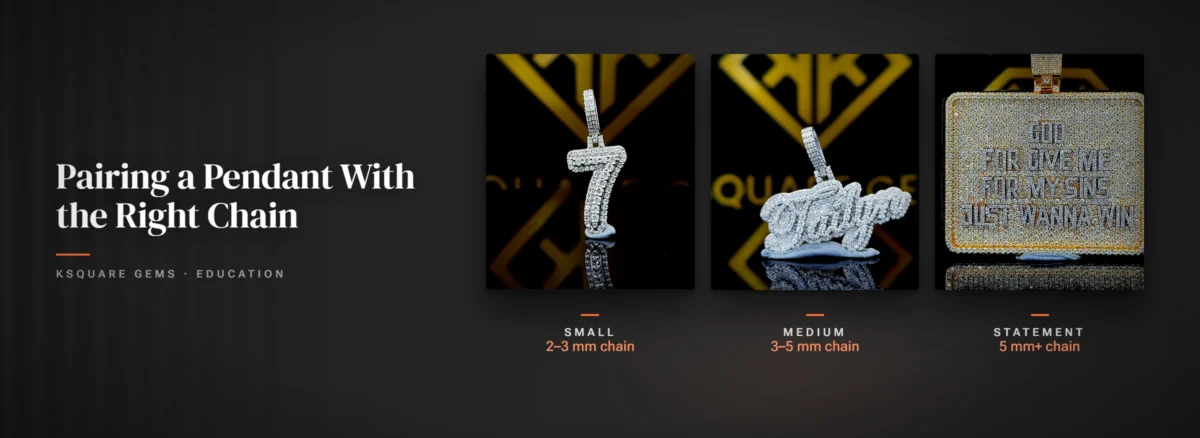
- Small pendants, such as round solitaires and small initials, sit best on a 2 to 3 mm chain. Anything heavier overwhelms them.
- Medium pendants look balanced on roughly 3 to 5 mm.
- Large and custom pieces need 5 mm and up, and the biggest statement pendants usually go wider still.
Width is only a rough proxy for strength. How the chain is made matters just as much. A hollow chain can look identical to a solid one of the same width and be far weaker, dented by a knock and prone to kinking. If the pendant has real weight to it, choose a solid chain and a clasp sized to match.
Check the bail before you buy the chain
The bail is the loop at the top of the pendant that the chain passes through. It is the most common reason a pairing fails: the chain looks right online and then simply will not go through.

- Measure the inside of the bail opening, height and width, in millimeters. Calipers are best; a fine ruler will do.
- Compare it with the chain’s thickness. The chain should pass through with a little room to spare, so the pendant can move.
- Then check the clasp end. To put the pendant on, you thread it over one end of the chain, and a lobster clasp or end cap is often bigger than the chain itself. Try whichever end is slimmer.
- Be careful with wide Cuban chains. Their box clasps are bulky and rarely fit through a bail, so the pendant has to go on over the narrower tongue end. If neither end clears the bail, that chain will not work with that pendant.
Keep the pendant facing forward
A pendant that keeps flipping around to show its back is one of the most common complaints, and it usually comes down to the chain rather than the pendant.
- Chain shape. Round chains, such as rope or a thin cable chain, let a pendant spin freely. Flatter or squarer chains, such as franco, box and Cuban, give the bail less room to rotate.
- Bail fit. A bail much bigger than the chain lets the pendant slide and turn. A closer fit, while still passing freely, keeps it steadier.
- Weight balance. A heavy pendant on a light chain swings and twists with every movement. A chain with some weight of its own holds it in place.
If yours keeps turning, try a flatter chain, a chain closer in size to the bail, or a slightly shorter length so the pendant rests against your chest rather than hanging free.
Chain styles that suit pendants
- Rope: twisted strands that catch the light along their whole length. Good with small and medium pieces, though its round profile lets a pendant spin.
- Franco: tightly woven V-shaped links with a square profile. Strong, flexible and slow to kink, and it holds heavier pendants facing forward.
- Box: small square links, smooth and plain. Understated, and slim box chains suit small pendants well.
- Cuban: thick interlocking curb links that lie flat. The classic partner for a large pendant; check the box clasp against the bail.
- Tennis: a continuous line of set stones. Iced on iced, with one extra job for you, explained below.
A tennis chain with an iced pendant is a deliberate look, and a good one, but it needs a little more attention. The bail rests on the same few settings all day and can wear them over time. Look at the stones under the bail every few weeks, and press each one gently with a fingernail to make sure none has started to move.
Match the metal
Our pendants are 925 sterling silver set with VVS1 moissanite. A white-toned pendant sits naturally on a silver, white gold or rhodium-plated chain; a yellow-toned piece on a yellow chain. Mixing colors can work, but it reads as a choice, so make it on purpose.
Hardness matters too. Stainless steel is harder than sterling silver, so a steel chain worn every day can slowly wear a groove into a silver bail. Plated chains have the opposite problem: the plating wears first where the bail rubs and at the back of the neck. For more on how these metals and coatings behave, see Gold, Silver and Plating Explained, and for keeping both pieces clean, How to Care for Silver and Gold Jewelry.
If you are still choosing the pendant itself, Pendant Styles Explained walks through the main designs, Your First Iced Out Piece helps with size, and you can browse the full range in our pendants collection.
Frequently Asked Questions
For most men, 20 to 24 inches is a good starting point, with 24 inches suiting medium and large pieces. Larger statement pendants often look best on 26 to 30 inches.
No. Our pendants are sold without a chain, so you can pair each one with the length, width and style you prefer.
Use a flatter chain such as franco, box or Cuban, choose a chain closer in size to the bail opening, or shorten the length slightly so the pendant rests against your chest.
It is not a good idea. A thin chain under a heavy pendant can stretch or break, usually at the clasp, and the pendant will swing and twist. Large pieces need a solid chain of 5 mm or wider.

Worldwide Delivery
Enjoy complimentary overnight shipping with fast delivery, ensuring convenience and prompt luxury service.
14 Days Returns
Experience peace of mind with our satisfaction guarantee, ensuring premium quality and unmatched customer service.
Lifetime Warranty
Shop with confidence, backed by verified trust ratings, secure transactions, and exceptional quality assurance every time.
24/7 Customer Support
We're here for you anytime, anywhere. Our dedicated customer support team is ready to assist you around the clock.