


Moissanite vs Cubic Zirconia: What Changes Over Time
New, moissanite and cubic zirconia look alike. After months of wear they do not: hardness, clouding, weight, testers and when CZ is fine.
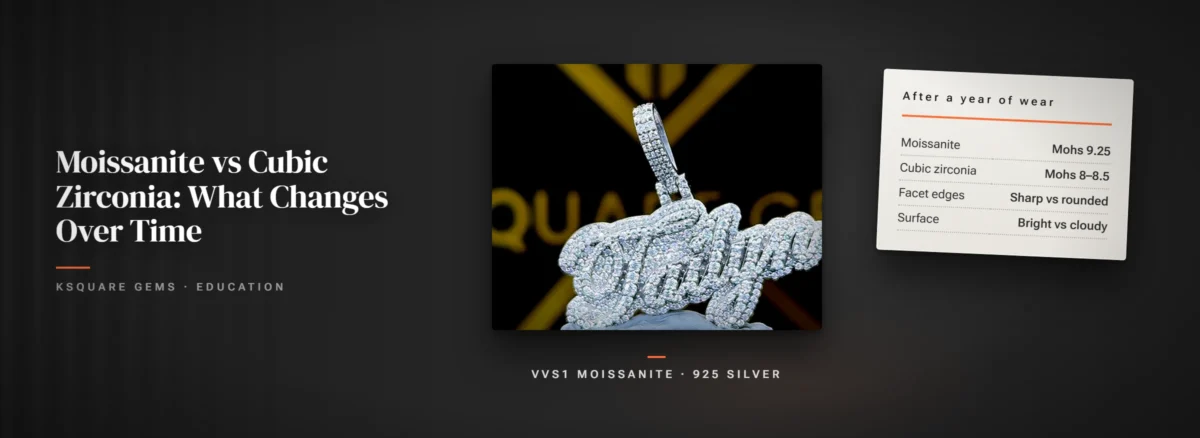
Quick Facts
Put a brand-new cubic zirconia next to a brand-new moissanite under shop lights and most people cannot tell which is which. Both are colorless, both are lab-made, both are cut into the same shapes. The difference shows up later, after months of being worn, knocked, brushed against and cleaned. This article is about that later.
On day one they are close
Cubic zirconia (CZ) is zirconium dioxide, grown in a lab and stabilized so it stays in its clear, cubic crystal form. Moissanite is silicon carbide, also grown in a lab. Fresh from the polishing wheel, a well-cut CZ is bright and white, with more colored fire than diamond. Moissanite goes further on both counts (Fire and Brilliance explains why):
| Property | Moissanite | Cubic zirconia |
|---|---|---|
| Hardness (Mohs) | 9.25 | 8 to 8.5 |
| Refractive index | 2.65 to 2.69 | About 2.15 to 2.18 |
| Dispersion (fire) | 0.104 | About 0.058 to 0.066 |
| Density (g/cm³) | About 3.2 | About 5.6 to 6.0 |
| Thermal diamond tester | Reads as diamond | Does not read as diamond |
Those numbers mean moissanite returns more light and throws more fire, but in a pavé pendant with small stones, under room light, the gap on day one is modest. If someone shows you two new pieces and says they look the same, they are not wrong. They are just looking too early.
Hardness, and why dust matters
Hardness on the Mohs scale tells you which materials can scratch which. Anything harder will scratch anything softer. The material that matters most for jewelry is quartz, at 7, because fine quartz particles are part of ordinary household dust and grit. Every time you wipe a dusty stone, brush it against a wall or drop it in a pocket with keys, those particles rub across the facets.

CZ at 8 to 8.5 is harder than quartz, so it does not scratch from a single wipe. But the margin is small, and CZ is also more brittle. Moissanite at 9.25 sits just below diamond and well above anything in normal dust, with a wide safety margin. Over thousands of small contacts, that margin is what separates the two.
What a year of daily wear does
Facet edges
The first place wear shows on CZ is the facet junctions, the sharp lines where two facets meet. They pick up tiny nicks and slowly round off. Under a loupe the edges look soft and chipped instead of crisp. On the hand it reads as a stone that has lost its snap: still bright, but blurrier. Moissanite edges hold their shape through years of normal wear.
Clouding
CZ is well known for going cloudy. Part of that is grime, since oils and lotion build up on any stone. The part that cleaning cannot fix is surface abrasion. Once the facets are covered in microscopic scratches, they scatter light like frosted glass and hold onto dirt, so the stone looks milky even straight after a wash. The only real fix is repolishing, which almost never makes sense for a CZ.
Moissanite gets dirty too, and a greasy moissanite can look surprisingly dull. The difference is that a soak in warm soapy water and a soft brush brings it back to how it looked new, year after year.

Weight and feel
CZ is dense. A CZ weighs roughly 1.75 times as much as a moissanite of identical size, and noticeably more than a diamond. In a large loose stone the difference is obvious on a scale. In a finished piece it is often not, because the metal makes up most of the weight. A heavy sterling silver pendant with 200 small stones will feel about the same in either material, so weight in the hand is not a reliable test for jewelry.
This density difference also explains why CZ and moissanite listings quote different carat weights for stones that look the same size. Compare stones in millimeters, as explained in Moissanite Cuts and Shapes.
Heat and testers
Moissanite conducts heat very well, not as well as diamond but far better than other gem materials. That is why it passes a basic thermal diamond tester, the kind many pawn shops and jewelers keep on the counter. CZ is a poor heat conductor and fails that test straight away. To tell moissanite from diamond, jewelers use a tester that also checks electrical conductivity, since moissanite conducts a little electricity and nearly all diamonds do not.
Heat matters at the repair bench too. Moissanite can temporarily turn yellowish when a jeweler heats the piece with a torch, then returns to its normal color as it cools. Tell your jeweler what the stones are before any repair or resizing so they plan the job around them.
When CZ is the right call
We sell moissanite, but CZ is a perfectly reasonable choice in some situations, and it costs a fraction of the price:
- Trend pieces: something you expect to wear for a season and then move on from.
- Costume and stage jewelry: pieces worn a few times for an event, a shoot or a performance.
- Trying a style: a cheap way to learn if you will really wear a big pendant or a heavy ring before spending more.
- High-loss settings: travel, festivals and anywhere a piece could easily go missing.
Where CZ makes less sense is a piece you plan to wear every day for years. That is exactly the situation where the slow wear on facet edges and the clouding catch up with it.
Telling them apart
- Loupe: using the method in Moissanite Clarity Grades, look at the facet edges through the side of a larger stone. Moissanite is doubly refractive and often shows doubled edges at an angle. CZ is singly refractive and never does.
- Wear: on a piece that has been worn a while, rounded, nicked facet edges point toward CZ.
- Tester: a combined diamond and moissanite tester will identify moissanite. A thermal-only tester will separate CZ from moissanite, since only moissanite reads as diamond.
- Ask a jeweler: most can identify the stone in a minute with standard equipment.
For the full background on moissanite, read What Is Moissanite?, and to keep any stone at its best, see How to Care for Silver and Gold Jewelry.
Frequently Asked Questions
Over time, yes. Oils and lotion build up on any stone and wash off, but CZ also collects fine surface scratches from everyday dust. Those scratches scatter light and trap dirt, so a well-worn CZ can look milky even after cleaning.
Very rarely. At Mohs 9.25 it is harder than the quartz in household dust and almost everything else it meets day to day. Only diamond and a few very hard industrial materials can scratch it. A hard knock can still chip any stone, including moissanite.
Yes, quickly. A thermal tester reads moissanite as diamond and CZ as not diamond, and under a loupe moissanite often shows doubled facet edges that CZ never shows.
For trend pieces, costume jewelry, short-term wear or anything at high risk of being lost, CZ is a sensible low-cost option. For a piece you will wear daily for years, moissanite holds its look much better.

Worldwide Delivery
Enjoy complimentary overnight shipping with fast delivery, ensuring convenience and prompt luxury service.
14 Days Returns
Experience peace of mind with our satisfaction guarantee, ensuring premium quality and unmatched customer service.
Lifetime Warranty
Shop with confidence, backed by verified trust ratings, secure transactions, and exceptional quality assurance every time.
24/7 Customer Support
We're here for you anytime, anywhere. Our dedicated customer support team is ready to assist you around the clock.