

Fire and Brilliance: How Moissanite Handles Light
Brilliance, fire and scintillation explained: why moissanite throws more color than diamond, and what cut, size and light change.
Quick Facts
Three things hiding inside one word
Customers ask us about sparkle more than any other quality of moissanite, and the word covers three separate effects that happen at the same time. Gemologists split them up like this:
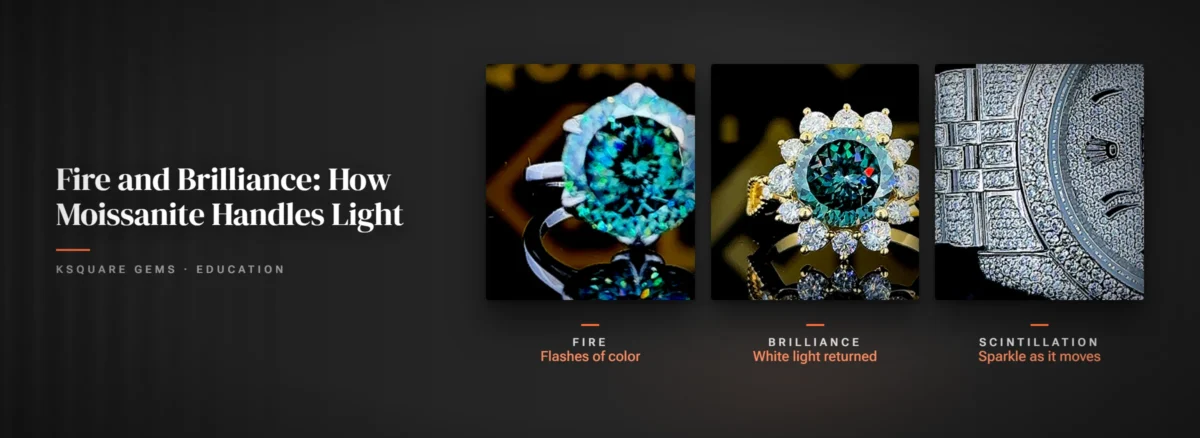
- Brilliance: the white light a stone sends back toward your eye. A stone with good brilliance looks lit from inside. A poor one looks glassy, gray or dark in the middle.
- Fire: flashes of spectral color, the reds, oranges, greens and blues that appear as the stone moves. It comes from dispersion, the way a material bends each wavelength of light by a slightly different amount.
- Scintillation: the on-and-off twinkle of light and dark patches as the stone, the light or your head moves. It is what makes an iced pendant look alive when you walk.
Moissanite scores well on all three, but fire is where it stands apart from diamond. Once you know how each one works, it gets much easier to judge a piece from photos and to understand why it looks one way on a video and another way at your kitchen table.
The path light takes through a round brilliant
Light enters through the table, the large flat facet on top. Inside the stone it travels down to the angled pavilion facets underneath. If it strikes them at a steep enough angle it cannot get out, so it reflects back up and leaves through the crown, toward you. That is total internal reflection, and the angle where it begins is set by the material’s refractive index (RI). The higher the RI, the wider the range of angles that stay trapped and get returned.
Moissanite’s RI is 2.65 to 2.69. Diamond’s is 2.42 and cubic zirconia sits around 2.15 to 2.18. On the way through, white light is also pulled apart into its colors. Moissanite’s dispersion is 0.104, more than twice diamond’s 0.044 and well above cubic zirconia at roughly 0.058 to 0.066. Higher dispersion means the colors fan out further before they leave the stone, so each flash of fire is wider and easier to see.

Moissanite has one optical habit that diamond lacks: it is doubly refractive, so light splits into two rays inside it. Cutters orient the rough so that you look down the direction where this shows least. In pavé stones you will never notice it. In a large stone seen at an angle through a loupe, the facet edges can look slightly doubled. That is the material, not a flaw.
What changes the sparkle you actually see
Cut
No material looks good when it is badly cut. A pavilion that is too shallow lets light leak out the bottom, and the middle of the stone looks see-through, a fault known as a window. Too deep, and light escapes through the sides, leaving dark zones. Moissanite’s high RI gives a cutter a little more margin than diamond, but proportions still count. A quick check on a pendant with a center stone: look straight down at it. The center should be bright, and you should not be able to read the color of your shirt through it.
Size
Fire needs room to show. In a round of about 6.5 mm, the size of a one carat diamond, the color flashes are broad enough to pick out one by one at arm’s length. In the 1 to 2 mm stones that cover an iced pendant, each flash is so small that your eye blends them, and what you see is a dense white glitter with the odd pinpoint of color. That is why a solitaire pendant and a fully iced piece can both be VVS moissanite and still look like different materials.

Lighting
Fire comes from point sources: the sun, a single bare bulb, LED downlights, a phone flashlight, the spotlights over a display case. Diffuse light, such as an overcast sky or the panel lights in an office, arrives from every direction at once and washes the colors out, leaving mostly white brilliance. The same pendant can throw rainbows across a restaurant table at night and look calm and white at your desk the next morning.
Cleanliness
This is the one you control. Total internal reflection depends on the pavilion facets having air behind them. Coat the underside of the stone with skin oil, lotion, sunscreen or soap residue and that film lets much more of the light leak out instead of bouncing back. A greasy moissanite looks gray and flat, and a pendant that rests against skin all day builds up that film within a few days. Warm water, a drop of mild dish soap and a soft brush bring it straight back. How to Care for Silver and Gold Jewelry walks through the full routine.
The “too much rainbow” debate
Moissanite’s fire divides people. Plenty of buyers choose it for exactly that, and the colored flashes are the whole point of an iced piece. Others find that a large moissanite under strong light looks like a disco ball, or obviously not diamond, and that bothers them. Both reactions are fair, and a few facts help put it in proportion:
- The effect is strongest in larger round brilliants under spotlights or direct sun. In ordinary indoor light it is much milder.
- Step cuts such as emerald and baguette give broad flashes of light and dark instead of scattered color, so they read calmer. Moissanite Cuts and Shapes compares them.
- In hip-hop pieces with dozens or hundreds of small stones, the color averages out into white glitter, so the debate barely applies.
- Product photos and videos exaggerate fire because they are usually shot under point lights against a dark background, the same setup described in How to Photograph Your Jewelry.
Who it suits
If your pieces are meant to be seen, moissanite’s fire works for you. Pendants worn out at night, statement rings, a watch with a stone-set bezel: these are lit by spotlights and phone cameras, and that is where moissanite looks its best. Grillz and pavé pendants also benefit, because small stones turn the extra dispersion into a brighter overall glitter.
If you want a quiet, white look for daytime and office wear, you have options. Smaller stones show less separated color. Step cuts tone the rainbow down. A rhodium-plated silver setting reflects white light back into the stones, while a yellow gold setting adds a warm tint to the overall look. Some people simply accept that the piece will light up under certain lamps and enjoy it when it does.
Judging sparkle before you buy
- Watch a video if one is available. Sparkle is movement, and a still photo only shows one frozen moment of it.
- Look for a shot in daylight or plain room light. That is how the piece will look for most of your day.
- For a single large stone, check that the center looks bright when seen straight from above.
- For pavé, check that the stones light up evenly. A dark spot in a row usually means a stone tilted in its seat, a missing stone or simply dirt.
- Compare stones by millimeter size rather than carat weight, since size is what decides how much fire you will see.
For the background on the stone itself, read What Is Moissanite?. You can see how our center stones and pavé behave on the chain in the pendants collection.
Frequently Asked Questions
It shows more fire, meaning colored flashes, because its dispersion is 0.104 against diamond's 0.044, and its higher refractive index returns plenty of white light. Whether that looks better is a matter of taste. Some people prefer diamond's whiter, calmer look.
Almost always a film of skin oil, lotion or soap on the underside of the stone. Soak it in warm water with a drop of mild dish soap, brush gently behind the stones with a soft toothbrush, rinse and dry.
Videos are usually shot under point lights against a dark background, which brings out the most fire. In diffuse daylight or office light the same stones look whiter and calmer. Hold the piece under a single bulb or your phone flashlight to see the effect again.
No. Dispersion is a property of the material and does not wear off. Only dirt or surface damage can reduce sparkle, and at Mohs 9.25 moissanite holds sharp facet edges far better than glass or cubic zirconia.

Worldwide Delivery
Enjoy complimentary overnight shipping with fast delivery, ensuring convenience and prompt luxury service.
14 Days Returns
Experience peace of mind with our satisfaction guarantee, ensuring premium quality and unmatched customer service.
Lifetime Warranty
Shop with confidence, backed by verified trust ratings, secure transactions, and exceptional quality assurance every time.
24/7 Customer Support
We're here for you anytime, anywhere. Our dedicated customer support team is ready to assist you around the clock.