
Moissanite Certificates: What a Grading Report Tells You
What a moissanite grading report lists, how to match the girdle inscription to it, and what a report does not prove.
Quick Facts
What a grading report is
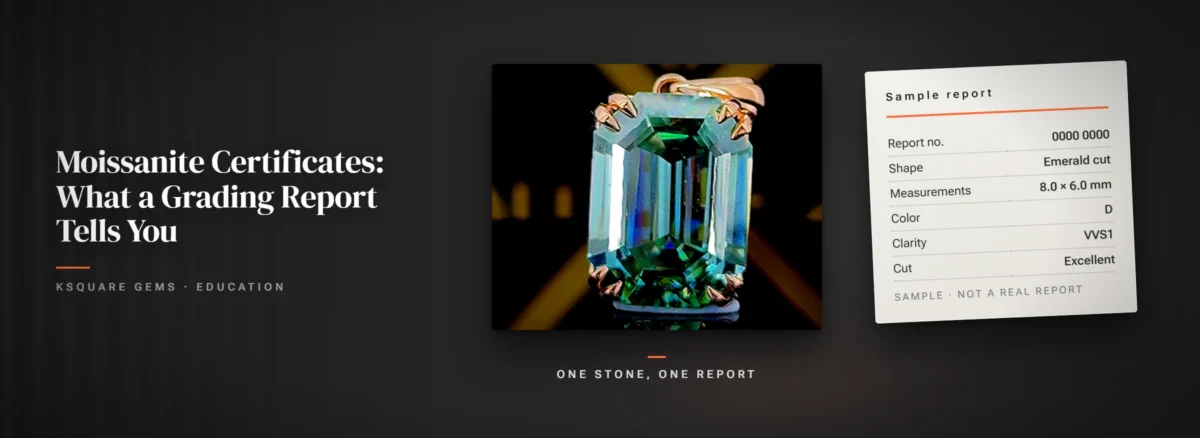
A grading report describes one specific stone: its shape, size, weight and the grades someone assigned for color, clarity and cut. For moissanite it is usually a small printed card, often about the size of a credit card, with a photo of the stone and a QR code. The lab name you will see most often on moissanite reports is GRA.
Sellers often call these cards certificates. The idea is useful: a report gives the stone an identity, and the number inscribed on the stone ties the two together. But a report is only as reliable as whoever issued it, and moissanite grading works quite differently from diamond grading. Knowing what the card can and cannot tell you saves a lot of confusion.
Reading the card, field by field

| Field | What it tells you | What to check |
|---|---|---|
| Report number | The unique ID for this stone’s record. | It should match the girdle inscription and the online record. |
| Shape and cut style | Outline and facet pattern, such as round brilliant. | It matches the stone you are holding. |
| Measurements | Size in millimeters, for example 6.50 mm across. | The most reliable way to compare size. A jeweler can gauge it. |
| Carat weight | Weight of the stone. | Whether it is actual weight or diamond equivalent weight (DEW). |
| Color | A letter grade borrowed from the diamond scale, usually D, E or F. | Graded loose, before setting. Metal color can shift how it looks. |
| Clarity | A grade such as VVS1, judged at 10x. | Should agree with what you see through a loupe. |
| Cut, polish, symmetry | Grades for proportions and finish, often “Excellent”. | Useful in principle, but standards are not published in detail. |
Carat weight deserves a second look. Moissanite is lighter than diamond, so a moissanite of a given size weighs less than a diamond of the same size. Some listings quote the weight a diamond of that size would have, called diamond equivalent weight. If a report and a listing disagree on weight, this is usually why. Millimeters avoid the problem. Moissanite Cuts and Shapes explains sizes in more detail.
The girdle inscription
The girdle is the thin edge around the widest part of the stone, where the top half meets the bottom half. Graded stones usually have the report number laser-inscribed there in tiny characters, too small to see without magnification. It is the physical link between the paper and the stone. Without it, a report could belong to any stone of a similar size.

Finding it takes some patience. The text is often at the very limit of a 10x loupe, and in a setting the prongs may cover part of it. To look for it:
- Clean and dry the stone so the girdle is free of film and dust.
- Use a 10x loupe, or higher magnification if you have it, with a bright light from the side.
- Rotate the piece slowly, looking at the girdle edge-on, until characters come into view.
- Read the number in full and compare it with the report number, character by character.
Any jeweler with a microscope can find and read an inscription in a minute or two if you struggle.
What a report does not tell you
- It is not an appraisal. A grading report says nothing about money. Insurance companies usually want a written appraisal from a qualified appraiser, which is a different document.
- It is not a diamond certificate. A moissanite report should name the stone as moissanite. Any document that suggests a moissanite is a diamond is a red flag.
- Grades are not standardized. Moissanite has no equivalent of the grading system the major diamond labs use, with published methods and master stones. A VVS1 on one report and a VVS1 on another are both meant to be very clean, but you cannot assume they were judged the same way. Moissanite Clarity Grades explains what the clarity letters mean.
- Independence varies. Many moissanite reports are issued in large volumes alongside the stones, and it is not always clear how independent the issuer is from the producer. That does not make them wrong, but it is not the same as an independent lab examining your one stone.
- It covers one stone only. The metal, the setting and any small accent stones are outside the report. A pendant with 150 pavé stones will not have a report for each of them.
How to check a report against a stone
- Look up the report number online through the lab’s website or the QR code.
- Find the girdle inscription and confirm it matches.
- Compare the shape, cut style and measurements with the stone. A jeweler can measure a loose stone accurately; in a setting, a gauge gets close.
- For a loose stone, a jeweler can weigh it and compare that with the report.
- Have the material confirmed with a moissanite tester if you want certainty. A report describes a stone; it does not prove the stone in front of you is moissanite.
Questions worth asking the seller
- Does this piece come with a grading report, and which stone does it cover?
- Is that stone inscribed, and does the inscription match the report number?
- Is the weight on the report actual weight or diamond equivalent weight?
- Who issues the report, and how can I verify it?
- What happens if the stone and the report do not match?
To ask us about paperwork for a specific piece before you order, email [email protected]. For anything after delivery, start with What to Check When Your Order Arrives and see our Refund & Return Policy.
When a report is worth having
A report is most useful for a single center stone of a decent size, such as a solitaire ring or a large solitaire pendant. It documents the stone, helps if you ever resell, and gives an insurer or appraiser something to start from. For iced pieces covered in small stones, a report adds very little, because the look depends on dozens of stones that are never graded individually.
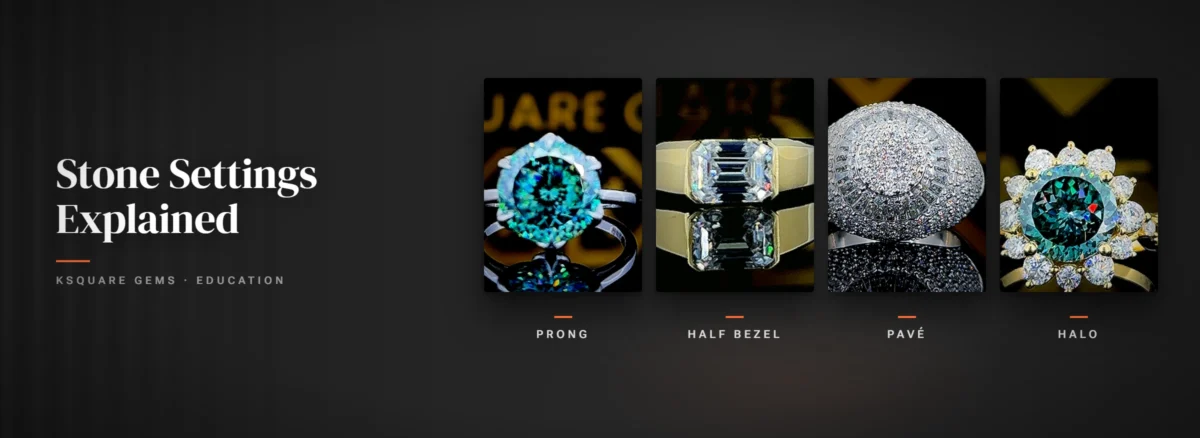
In every case, the clearest protection is a seller who states the materials plainly: the metal, the stone, its color and clarity. For the basics on the stone itself, read What Is Moissanite?, and for how the stones are held in a piece, see Stone Settings Explained.
Frequently Asked Questions
GRA is the name most often printed on moissanite grading reports. The card lists the stone's report number, shape, measurements, weight and color, clarity and cut grades, and usually links to an online record. It describes the stone; it is not an appraisal.
No. Major diamond labs grade diamonds to published standards. Moissanite has no shared grading standard, so grades on moissanite reports are useful guidance but not strictly comparable between issuers.
Clean the stone, then look at the girdle edge-on with a 10x loupe and a side light, rotating slowly. The characters are tiny and may sit under a prong. A jeweler with a microscope can find it quickly if you cannot.
It helps describe the stone, but most insurers ask for a written appraisal that states a value. A grading report does not include one.

Worldwide Delivery
Enjoy complimentary overnight shipping with fast delivery, ensuring convenience and prompt luxury service.
14 Days Returns
Experience peace of mind with our satisfaction guarantee, ensuring premium quality and unmatched customer service.
Lifetime Warranty
Shop with confidence, backed by verified trust ratings, secure transactions, and exceptional quality assurance every time.
24/7 Customer Support
We're here for you anytime, anywhere. Our dedicated customer support team is ready to assist you around the clock.