


Skeleton Watches: How to Read an Open Dial
What openworking is, how to read the time on a busy open dial, skeleton vs open heart vs exhibition caseback, and how to keep one clean.

Quick Facts
The first time most people put on a skeleton watch, they spend a second or two hunting for the hands. That is part of the appeal. You are looking through the dial into layers of metal, gears and bridges instead of at a flat painted surface. It is also the main trade-off, and with a few habits it stops being a problem.
What openworking actually is
A conventional watch hides its mechanism behind a solid dial. Openworking, also called skeletonizing, removes as much of that solid metal as possible. The dial is cut back or removed, and the plates and bridges that hold the moving parts in place are cut down to a thin framework. What remains is just enough structure to do the job, so you can see the wheels turning behind the hands and, in some designs, light coming through from the back of the case.
Traditionally this was done by hand with a fine saw and then engraved and polished. Today most openworked parts are cut by machine. How much of the movement you actually see varies from watch to watch. On some, nearly everything behind the hands is working mechanism. On others, part of the view is a decorative openworked plate or dial layer designed for the look, with movement parts visible through it. Both are common designs. If seeing a working movement matters to you, ask the seller what is visible on a particular model. For how the two main movement types differ, read Quartz vs Automatic Movements.
Skeleton, open heart or exhibition caseback
These three terms get mixed up on listings. They describe different things:
| Style | What you see | How easy to read |
|---|---|---|
| Full skeleton | Most of the dial and bridges cut away. You see through the watch from the front. | Hardest. Hands sit over a busy background. |
| Openworked dial | Part of the dial cut away, usually around the center, with a solid ring or sections left. | Good, if the hour markers stay on a solid ring. |
| Open heart | A small window in a normal dial, usually showing the balance wheel of a mechanical watch. | Easy. The rest of the dial is solid. |
| Exhibition caseback | A clear crystal in the back of the case. The front dial is normal. | Easy. You only see the works when the watch is off. |
Anatomy of an open dial
An open dial has more going on than a solid one, but the parts that matter for reading the time are the same. It helps to know what you are looking at:

- Hands: the hour and minute hands sit on top of everything else. Good skeleton designs make them wider, polished or colored so they stand off the background.
- Openworked bridges: the cut-out frames that hold the wheels in place. They are the lines and arches you see under the hands.
- Visible gears: the toothed wheels behind the bridges. Some turn slowly enough that you only notice movement if you watch for a minute.
- Bezel: the ring around the crystal. On iced models it is stone-set, which frames the dial with a band of light.
- Crown: the knob on the side used to set the time. On most watches it sits at 3 o’clock.
Reading the time on a busy dial
- Orient the watch. With the crown on your right, 12 is at the top. On a dial with few markers, this alone gets you halfway.
- Find the hands, not the numbers. Look for the two longest pieces that cross the center. The hour hand is shorter and usually broader.
- Use the outer edge. Most skeleton watches keep a ring of markers or a minute track around the edge of the dial, or markers on the bezel. Follow the minute hand straight out to that ring.
- Read the hour by position. You rarely need to see the hour hand’s exact tip. Its angle relative to 12 and 3 tells you the hour.
- Tilt it to the light. Polished hands catch light at a different angle from the brushed or plated parts underneath, so a small tilt makes them flash and stand out.
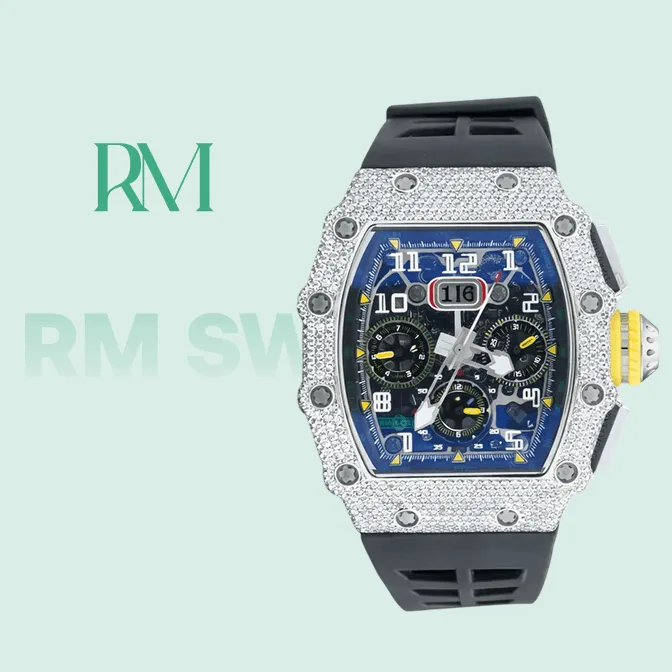
Sport chronograph styles add small sub-dials and extra hands. Ignore those for the time of day. The time is read from the long hour and minute hands at the center.
Choosing a skeleton you can actually read
Some open dials are easy to read and some are pure decoration. Before you buy, look at a photo of the dial at full size and check for:
- Contrast: silver or white hands over a dark or blue-tone movement, or dark hands over silver bridges. Hands the same color as the bridges disappear.
- Hand width: wide, faceted or filled hands read better than thin sticks.
- A solid ring of markers: hour markers on a solid outer ring make the time readable even when the center is very busy.
- Stone placement: an iced bezel frames the dial and helps legibility. Stones set across the hands or the bridges as well add sparkle but make the time harder to read.
Keeping an open dial looking clean
An open dial looks lighter and airier than a solid one, but it is less forgiving. A speck of dust or a fiber that gets inside the case sits on a bridge in full view, with nothing to hide behind. You cannot clean it from the outside, and opening the case at home risks letting in more dust and moisture. If something gets inside, take the watch to a watchmaker.
The outside needs the same care as any iced watch, with a little extra attention:
- Wipe the crystal with a dry microfiber cloth. Fingerprints and smudges are more visible over an open dial because there is no solid background to hide them.
- Brush a stone-set bezel gently with a soft, dry or barely damp toothbrush to lift dirt from around the stones.
- If the watch has a clear caseback, wipe it too. It rests against skin and collects oil quickly.
- Never soak the watch or hold it under running water.
The full routine is in How to Clean an Iced Out Watch.
Wrists, cases and outfits

A skeleton dial is already busy, so it works best with simple clothes: a plain T-shirt, a solid-color shirt, a dark knit. Pattern on pattern competes, and the watch loses. How to Wear an Iced Out Watch has outfit-by-outfit advice. Let it be the one detailed thing on your arm and keep other jewelry quieter.
The case shape changes the character of the watch:
- Square case: structured and slightly dressy. A square case covers more of the wrist than a round one of the same width, so it wears a little larger (the Watch Size Guide explains why). A slim one sits well under a shirt cuff.
- Tonneau sport chronograph: a barrel-shaped case, curved at the sides, with a strong sporty presence. It suits streetwear and casual outfits, and medium to larger wrists carry it most easily.
- Blue-tone tonneau: the same barrel shape in a cooler color. Blue works with denim, navy, gray and black, which makes it the easiest of the three to wear day to day.
On a slimmer wrist, a lot of visible detail can make a watch look bigger than it is. A darker or blue-tone movement and a solid ring of markers keep it calmer. On a larger wrist, a bright silver or gold-tone openwork has room to show off. To see the open-dial designs we carry, browse the watches collection.
Frequently Asked Questions
A skeleton watch has most of its dial and the structure behind it cut away, so you see through much of the watch. An open heart has a normal dial with one small window, usually over the balance wheel of a mechanical watch.
They take a day or two to get used to. Orient the watch with the crown on your right, find the two long center hands, and read the minutes against the ring of markers at the edge. Hands that contrast with the movement make it much easier.
No. Dust or fibers inside the case need a watchmaker, who can open it in a clean environment. At home, clean only the outside: the crystal, the bezel and the bracelet or strap.
No. An exhibition caseback is a clear crystal in the back of the case. The dial on the front can be completely solid. A skeleton watch is open from the front.






Worldwide Delivery
Enjoy complimentary overnight shipping with fast delivery, ensuring convenience and prompt luxury service.
14 Days Returns
Experience peace of mind with our satisfaction guarantee, ensuring premium quality and unmatched customer service.
Lifetime Warranty
Shop with confidence, backed by verified trust ratings, secure transactions, and exceptional quality assurance every time.
24/7 Customer Support
We're here for you anytime, anywhere. Our dedicated customer support team is ready to assist you around the clock.