
Watch Crystals: Mineral, Sapphire and Acrylic Compared
Mineral glass, sapphire and acrylic: how each handles scratches and knocks, how to tell them apart and how to keep yours clear.
Quick Facts
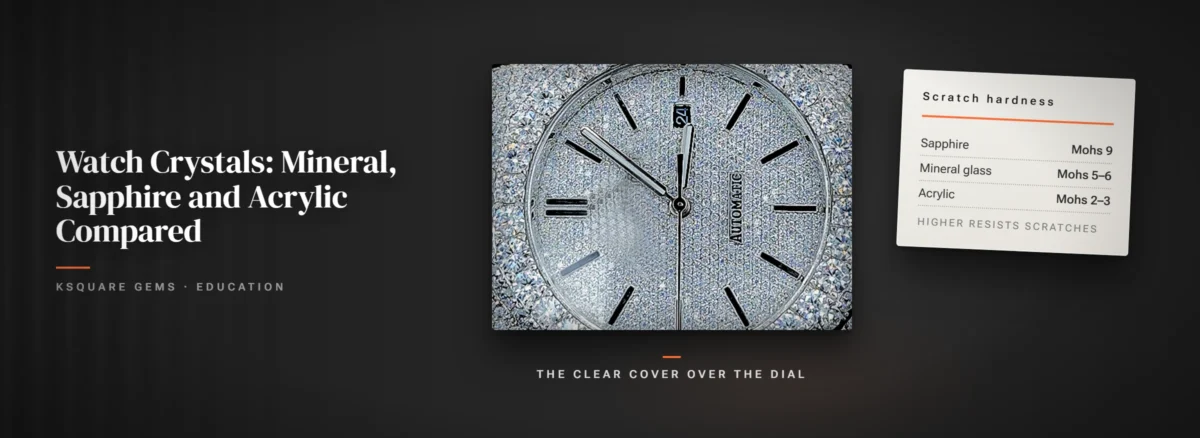
The clear cover over the dial
Watchmakers call the clear cover over the dial the crystal, even though on most watches it is glass or a lab-grown gem. It keeps dust, moisture and fingers away from the dial and hands, and it seals against the case with a gasket. It can be flat or domed, and some designs add a small magnifier over the date window.
Three materials cover almost every watch made today: mineral glass, sapphire and acrylic. Each one makes a different trade between resisting scratches and surviving a knock, and no single material wins on both.
Mineral glass
Mineral crystal is glass that has usually been hardened with heat or chemical treatment. It sits around 5 to 6 on the Mohs hardness scale. It is clear, inexpensive to make and to replace, and it handles everyday wear well.
Its weak point is scratches. Ordinary dust and sand contain quartz, which is about 7 on the Mohs scale, harder than the glass. Wipe a gritty crystal with a dry cloth, brush it along a brick wall or drop it face down on a sandy surface and you can leave fine hairlines. A hard knock on the edge can also chip or crack it.
Our watch listings specify mineral crystal glass. That is common across iced watches, where the case, bezel and stones carry the design and the crystal is a practical cover. With sensible care it stays clear for a long time, and if it is ever damaged it is a straightforward part for a watchmaker to replace.
Sapphire
Sapphire crystal is synthetic sapphire, grown in a laboratory from aluminum oxide. It is 9 on the Mohs scale, so dust, keys, coins and steel won’t scratch it. Very few everyday materials can, but diamond and moissanite can, because they are harder still. An iced ring or a loose moissanite pendant rattling against your watch in a drawer can mark even sapphire.
The trade-off is brittleness. Sapphire resists scratches extremely well but can chip or shatter from a sharp, edge-on blow. It is also harder to cut and polish, which makes it more expensive.
Sapphire has a higher refractive index than glass, roughly 1.77 against about 1.5, so it reflects more light. That is why many sapphire crystals have an anti-reflective coating. A coating on the inside surface is protected. A coating on the outside cuts glare further, but it can wear or scratch over time and leave a patchy look, even though the sapphire underneath is fine.
Acrylic
Acrylic is a clear plastic, about 2 to 3 on the Mohs scale. It scratches easily, but it flexes on impact and very rarely shatters. Light scratches can be polished out at home with a plastic polishing compound and a soft cloth, which is something you can’t do with glass or sapphire.
It has a warm, slightly vintage look, especially when domed, and it can show a little distortion near the edge. You find it mostly on vintage-style and some sport watches. It is rare on iced watches.

| Crystal | Mohs hardness | Scratches | Hard knock | Fixing scratches |
|---|---|---|---|---|
| Acrylic | About 2 to 3 | Easily | Flexes, rarely shatters | Polishes out at home |
| Mineral glass | About 5 to 6 | From dust, sand, grit | Can chip or crack | Light ones by a watchmaker, else replace |
| Sapphire | 9 | Only by harder materials | Can chip or shatter on the edge | Replace |
How to tell them apart
The listing should tell you, but if you are looking at a watch without one, a few simple checks help.
- The water drop test. Clean and dry the crystal, then put one small drop of water on it. On sapphire the drop tends to stay in a tight bead. On mineral glass or acrylic it spreads out flatter. Dirt, skin oil and anti-reflective coatings can affect the result, so clean the crystal first and treat it as a hint, not proof.
- The tap test. Tap the crystal lightly with a fingernail. Acrylic gives a dull, soft knock. Glass and sapphire give a sharper click. This separates plastic from glass well, but it won’t reliably tell mineral glass from sapphire.
- The wear test. A watch that has been worn for a while tells you a lot. Fine hairline scratches across the face point to mineral glass or acrylic. A crystal that still looks perfect after years of daily wear is likely sapphire.
- The reflection test. Tilt the watch under a light. A bluish or purple sheen points to an anti-reflective coating, which is most common on sapphire.

Caring for a mineral crystal
Most crystal scratches come from a handful of habits, which makes them easy to avoid.
- Never wipe grit dry. Dust is harder than the glass. Lift it first with a soft brush or a barely damp microfiber cloth, then polish with a dry microfiber.
- Skip paper towels and shirt hems. They can carry grit. A microfiber cloth kept in its own pouch is cheap and much safer.
- Store it apart. Keep the watch in its own compartment or on a cushion, not loose with keys, coins or other jewelry. Moissanite is harder than glass and sapphire, so iced pendants and rings should never share a space with a watch face. How to Store Jewelry shows a simple layout.
- Mind your desk. Typing with a watch on drags the case across the desk all day. A few millimeters of clearance or a soft desk mat makes a difference.
- Take it off for rough jobs. Workouts, moving furniture and yard work are when most chips happen.
When the crystal is scratched or cracked
Light scratches on mineral glass can sometimes be polished by a watchmaker, though polishing too deep can leave the surface slightly wavy. Deeper scratches are usually best solved with a new crystal, a routine job that involves opening and resealing the case.
A crack or chip is more urgent. Glass fragments can work loose inside and jam the hands, and a broken seal lets in moisture and dust.
For everyday cleaning around the stones and bracelet, see How to Clean an Iced Out Watch. To see why moissanite can scratch even sapphire, read What Is Moissanite? If you have a question about a watch you have bought from us, email [email protected].
Frequently Asked Questions
Our watch listings specify mineral crystal glass. Check the listing of the specific watch for its details.
Yes. Dust and sand contain quartz, which is harder than mineral glass, so wiping grit across it or knocking it on rough surfaces can leave fine scratches.
No. It is very scratch resistant but brittle, and a sharp blow on the edge can chip or shatter it.
Check the listing first. The water drop test helps: on clean sapphire a drop tends to bead up tightly, while on mineral glass it spreads. A crystal with no scratches after years of wear is also a good sign.


Worldwide Delivery
Enjoy complimentary overnight shipping with fast delivery, ensuring convenience and prompt luxury service.
14 Days Returns
Experience peace of mind with our satisfaction guarantee, ensuring premium quality and unmatched customer service.
Lifetime Warranty
Shop with confidence, backed by verified trust ratings, secure transactions, and exceptional quality assurance every time.
24/7 Customer Support
We're here for you anytime, anywhere. Our dedicated customer support team is ready to assist you around the clock.