
Watch Size Guide: Matching Case Size to Your Wrist
Measure your wrist, check lug-to-lug before diameter and allow for the stones: how to choose a watch size that sits right.
Quick Facts
Start with your wrist, not the watch
Most sizing mistakes start with a case size picked from a forum post and a wrist that never got measured. Measuring takes two minutes. Wrap a soft tailor’s tape around your wrist just above the wrist bone, where the watch will actually sit, snug but not tight. If there is no tape in the drawer, use a strip of paper or a phone charging cable, mark where it overlaps, then lay it flat against a ruler.
Write the number down in both units. For reference, 6.5 inches is about 16.5 cm, 7 inches is about 17.8 cm and 7.5 inches is about 19 cm. Measure the wrist you wear a watch on, because left and right are often slightly different.
Then look at the shape of your wrist from above. Some wrists are flat and broad across the top, others are rounder and narrower. A flat wrist gives the watch a wide platform and can carry a bigger case than its circumference suggests. A round wrist with the same measurement has less flat space, so the same watch starts to overhang sooner.
Case diameter: the number on the listing
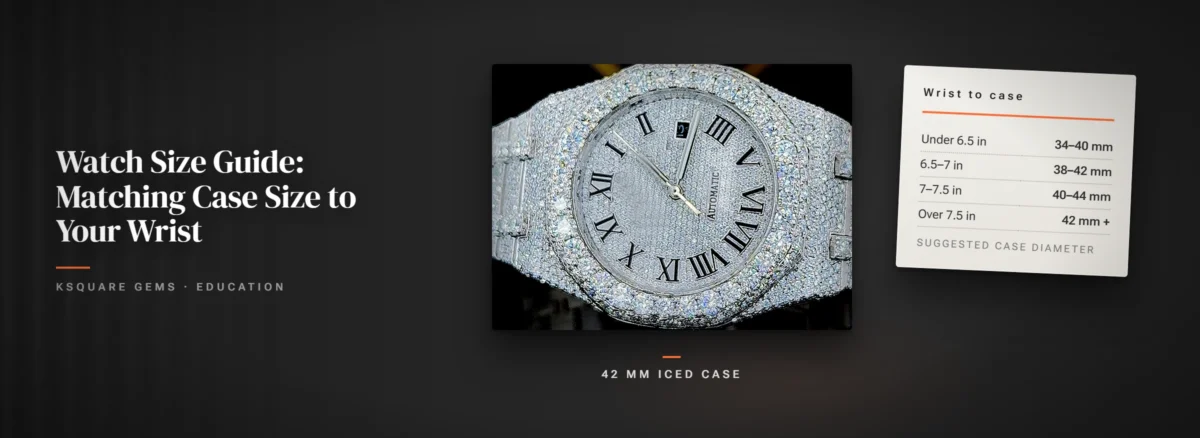
Case diameter is the width of the case across the dial, usually measured from 9 o’clock to 3 o’clock without the crown. It is the figure most listings lead with, and most of our watches use a 42 mm stainless steel case.
Diameter is a fair starting point, but on its own it can mislead. Two 42 mm watches can wear quite differently depending on how far the lugs reach, how thick the case is and how much of the face is bezel rather than dial. A thin bezel around a big open dial looks larger than a broad bezel around a smaller dial, even at the same diameter.

Lug-to-lug: the measurement that decides the fit
Lug-to-lug is the distance from the tip of the top lugs to the tip of the bottom lugs, in other words the length of the watch head along your arm. This is the number that tells you whether a watch fits, because the lugs are the part that can hang off the edge of your wrist.
The test is simple: the lug tips should sit on top of the wrist, inside its edges. When they overhang, the bracelet drops away at a sharp angle, a gap opens under the case and the head slides around during the day. If you already own a watch that fits well, measure its lug-to-lug with a ruler. That one number is the best reference you have for anything you buy next.
On octagonal sport watches and other designs where the bracelet flows straight out of the case, the first link does the job of the lugs. How far that link can bend matters. A stiff first link makes the watch wear longer than its case measurement suggests, so look at side-on photos to see how the bracelet curves away from the case.
Listings don’t always quote lug-to-lug. If it is missing, you can estimate it from a straight-on photo using the case diameter as a scale, or email [email protected] and ask.
Thickness and cuff clearance
Thickness runs from the caseback to the top of the crystal, and on an iced watch the stone-set bezel adds height because the stones sit above the metal. A thicker case sits higher on the wrist, catches on sleeves and can feel top-heavy if the bracelet is loose.
As a rough guide:
- Around 10 mm or less: slides under most dress shirt cuffs without fuss.
- Around 11 to 13 mm: fine with a slightly roomier cuff, or with the cuff button moved over.
- Thicker than that: happiest with short sleeves, knitwear with some stretch, or worn on show outside the cuff.
Weight plays a part too. A steel watch with a fully set bracelet is noticeably heavier than a plain one, and a heavy head on a loose bracelet will roll to the side of the wrist. Wear it a little snugger than you would a light watch.
Why iced watches wear larger
Put a plain steel watch and an iced watch of the same diameter side by side and the iced one will look bigger. Three reasons:
- The edge lights up. On a polished steel bezel the outer edge fades into the background. A stone-set bezel throws light right out to the rim, so the eye reads the full width.
- The stones add height. Prong and pavé settings raise the bezel a little, which makes the case look chunkier from the side.
- A set bracelet keeps going. When the bracelet is iced too, the sparkle runs past the lugs and the whole thing reads as one large piece.
None of this is a problem. On a smaller wrist a 42 mm iced watch is a bold look, and for many buyers that is the whole point. Just go in knowing it will read larger than a plain 42 mm watch, and if you sit between two sizes, the smaller one is usually the safer pick in an iced version.
Square, round and octagonal cases
Shape changes how a size number feels. On a round case the diameter tells you most of the story. A square case measured at the same width covers more of the wrist: a 40 mm square has about 27% more face area than a 40 mm circle, and its corners reach further toward the edges of the wrist. Many people go a few millimeters smaller in a square case than they would in a round one.
Tonneau, or barrel-shaped, cases are longer than they are wide, so lug-to-lug and overall length matter more than width. Octagonal sport cases are broad and flat with an integrated bracelet, and they wear wide across the top of the wrist, which suits flatter wrists particularly well.
Size chart by wrist circumference
Use this as a starting point, then adjust for wrist shape and for how bold you want the watch to look.

| Wrist circumference | Case diameter | Lug-to-lug |
|---|---|---|
| Under 6.5 in (under 16.5 cm) | 34 to 40 mm | Up to about 46 mm |
| 6.5 to 7 in (16.5 to 17.8 cm) | 38 to 42 mm | About 44 to 48 mm |
| 7 to 7.5 in (17.8 to 19 cm) | 40 to 44 mm | About 47 to 51 mm |
| Over 7.5 in (over 19 cm) | 42 mm and up | About 50 mm and up |
A 42 mm case lands right in the middle of that chart. It sits comfortably on most wrists from about 6.75 inches up. Below 6.5 inches it will look deliberately large, especially with an iced bezel, so check the lug-to-lug against the width of your wrist before deciding.
Fit is the last step
A watch that is the right size can still look wrong if it hangs loose. It should sit just above the wrist bone and move a little, not spin. With a strap that means the hole that lets one finger slip underneath; with a bracelet it usually means adjusting the links, ideally at a jeweler or watchmaker if the links are stone-set. How to Size a Watch Bracelet walks through it, and How to Wear an Iced Out Watch covers cuffs and wrist position.
For more on keeping a watch looking right once it fits, see How to Clean an Iced Out Watch and Stone Settings Explained. If you are still deciding what goes inside the case, Quartz vs Automatic Movements covers that. When you have your numbers, you can compare them against our watches.
Frequently Asked Questions
On wrists under about 6.5 inches it will look large, more so with an iced bezel. Check that the lug tips stay on top of your wrist. If they do, it can work as a deliberate statement.
The distance from the tip of the top lugs to the tip of the bottom lugs. It is the best single guide to fit, because lugs that overhang the wrist make a watch sit badly.
Wrap a strip of paper or a cable around your wrist just above the bone, mark where it overlaps, then measure the strip flat against a ruler.
Yes. A stone-set bezel lights up the edge of the case and adds a little height, so an iced watch reads larger than a plain watch of the same diameter.

Worldwide Delivery
Enjoy complimentary overnight shipping with fast delivery, ensuring convenience and prompt luxury service.
14 Days Returns
Experience peace of mind with our satisfaction guarantee, ensuring premium quality and unmatched customer service.
Lifetime Warranty
Shop with confidence, backed by verified trust ratings, secure transactions, and exceptional quality assurance every time.
24/7 Customer Support
We're here for you anytime, anywhere. Our dedicated customer support team is ready to assist you around the clock.