

Stone Settings Explained
Prong, bezel, pavé, channel and halo: how each one holds a stone, and what to check before you buy.
Quick Facts
Why the setting deserves a closer look
The setting is the metalwork that holds each stone in place. It affects how much light reaches the stone, how secure it is, how the piece feels against skin and clothing, and how easy it is to keep clean. On an iced-out watch or a pavé pendant there can be hundreds of individual settings in one piece, so the quality of that work is a large part of what you are paying for.

Prong setting
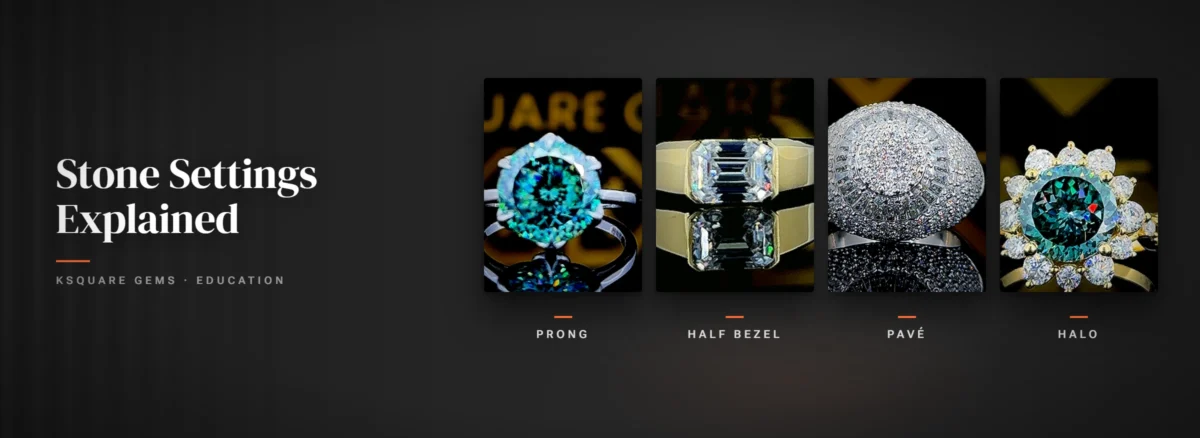
Prongs are small metal claws that rise up around the stone and fold over its edge. Four prongs show off the most of the stone; six hold it more securely and keep a round looking round even if one prong takes a knock. Because so little metal covers the stone, light enters from the sides as well as the top, which is why prongs are the classic choice for solitaires.
What to watch for: prong tips that catch on knitwear or hair. A well-finished prong is smooth and rounded on top. Prongs also wear down slowly over years of wear, and a jeweler can rebuild them, a job known as re-tipping.
Bezel setting
A bezel is a thin wall of metal that wraps around the edge of the stone. It is the most protective setting there is: nothing sticks out to snag, and the girdle, the thin outer edge where a stone is most likely to chip, is covered. A half bezel covers two sides and leaves the others open, letting in more light while still guarding the corners. Our emerald-cut solitaire, pictured at the top of this page, uses one.
A full bezel lets in less light from the side, so the stone can look fractionally smaller than it would in prongs. For a ring you wear to work, train in or simply never take off, that trade-off is usually worth it.
Pavé setting
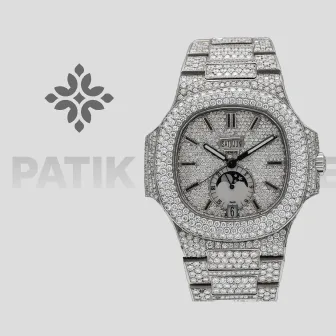
Pavé, from the French for “paved”, covers a surface in small stones set close together, each held by tiny beads of metal raised from the surface around it. Done well, it reads as one continuous sheet of light. It is the setting behind almost every iced-out piece: the dials and bracelets of our watches, our grillz and most of our pendants.

What to watch for: straight, even rows, stones that sit level with their neighbors, and no gaps or empty seats. Run a fingertip across the surface. It should feel smooth rather than scratchy. When the stones are very small, you will sometimes see this called micro pavé.
Channel setting
In a channel setting, stones sit in a row between two parallel walls of metal, with no metal between them. Their edges are tucked under the walls, so the surface is smooth and well protected. Square and rectangular stones such as princess and baguette cuts suit channels best, and you will see them in bands and in rows of baguettes on rings and bezels.
Halo setting
A halo is a ring of small stones around a center stone, each usually held in its own small prongs. It makes the center stone look larger and adds sparkle around it, and it also shields the center stone’s edge. Halos work especially well around a colored center, where a frame of white stones makes the color stand out.
The main settings compared
| Setting | Security | Light to the stone | Snagging | Cleaning |
|---|---|---|---|---|
| Prong | Good | Excellent | Some risk | Easy |
| Bezel | Excellent | Good | Very low | Easy |
| Pavé | Good when well made | Excellent overall sparkle | Low | Needs a soft brush |
| Channel | Very good | Good | Very low | Dirt can sit in the channel |
| Halo | Good | Excellent | Some risk | Needs a soft brush |
How to check a setting yourself
- Look at the piece in bright light, ideally with a 10x loupe or your phone camera zoomed in. Every stone should be touched by its prongs or beads on all sides.
- Check that the stones sit level. A tilted stone usually means it was not seated properly.
- Hold the piece next to your ear and tap it gently with a fingernail. A loose stone gives a faint click or rattle.
- Draw it lightly across a soft sweater. If it catches, a prong tip has lifted.
Settings are only half the story. For the stones themselves, see Moissanite Cuts and Shapes, or browse our pendants and watches with these settings in mind.
Frequently Asked Questions
A bezel. The metal surrounds the stone, fully or on two sides, so it is very hard to knock loose.
Yes, when it is well made. Each small stone is held by several beads of metal. Avoid hard knocks and ultrasonic cleaners, and have pieces you wear daily checked every six months or so.
Usually a prong tip has lifted slightly. A jeweler can smooth or re-tip it quickly, and it is worth doing before the stone loosens.
Four prongs show more of the stone; six hold it more securely and keep a round stone looking round. For a ring worn every day, six is the safer choice.








Worldwide Delivery
Enjoy complimentary overnight shipping with fast delivery, ensuring convenience and prompt luxury service.
14 Days Returns
Experience peace of mind with our satisfaction guarantee, ensuring premium quality and unmatched customer service.
Lifetime Warranty
Shop with confidence, backed by verified trust ratings, secure transactions, and exceptional quality assurance every time.
24/7 Customer Support
We're here for you anytime, anywhere. Our dedicated customer support team is ready to assist you around the clock.